
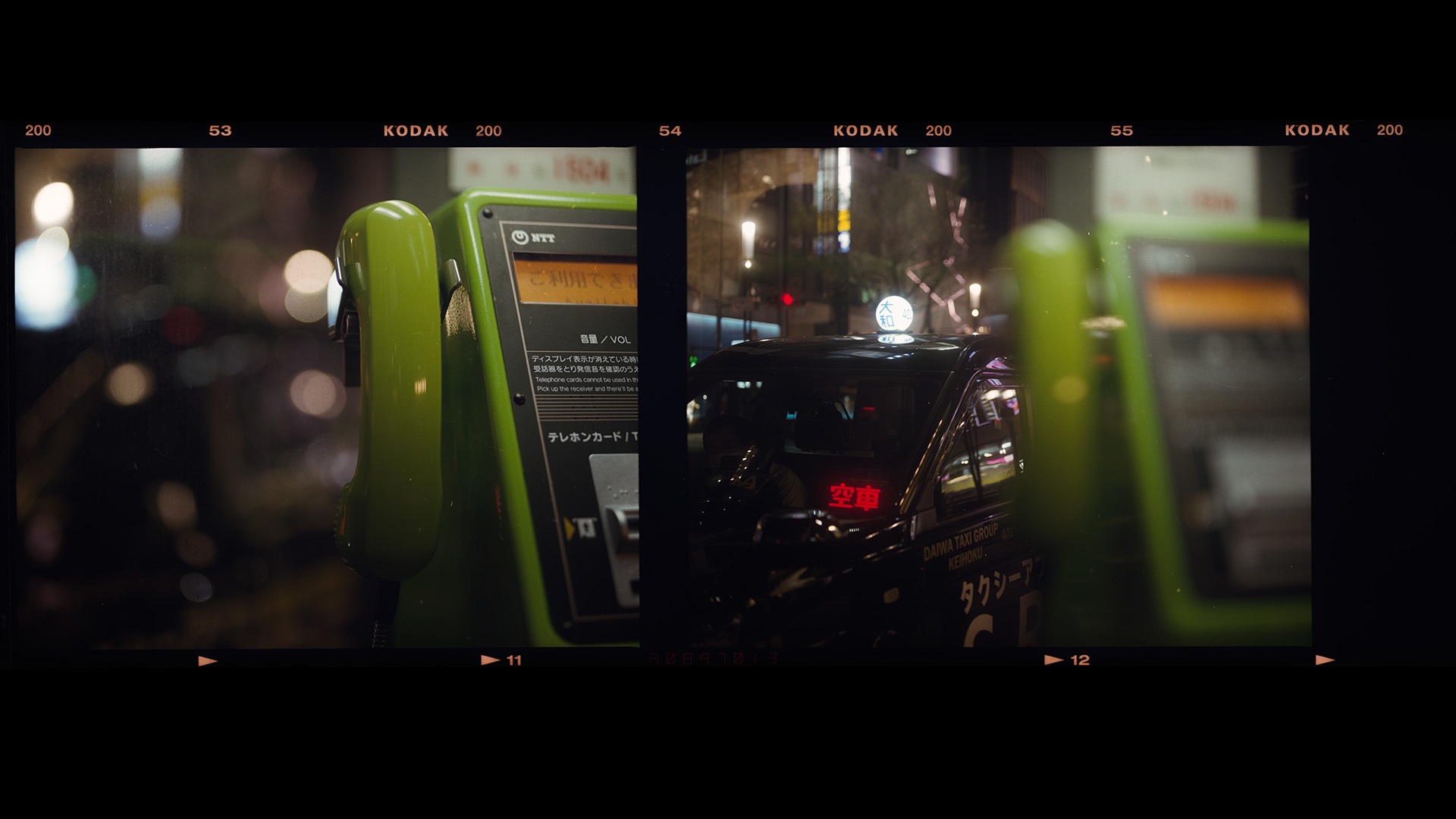
写真家、村田啓さんによる連載「光景|All I Can See」。銀座という舞台を通して、人の視覚とその奥に潜む不思議さを見つめ直します。
今回は、音楽と映像、そのあいだに立ち上がる没入感について。目に見える情景だけでは捉えきれない感覚が、身体の震えや記憶の揺らぎとともに、静かに風景を描き出していきます。
#7 「MIBKVD」
my bloody valentine(以下マイブラ)のライブを見たときに、それをとても映画的だと感じられたことに驚いたのと同時に、多くの映画は具象的なものなのかもしれない、と思った。
例えば、カフェでお茶をしている男性が映るカットでは、彼の服装やロゴからブランドを推測することができるし、テーブルの上に置かれたタバコの銘柄や、広げた新聞のどの記事に目を通しているのか、まで視覚的に確認することができる。そこでは「何がうつっているか」によって状況が描かれている。
一方で、マイブラのライブではそれとは違う形で情景が立ち上がっていた。視覚的な情報としては、演奏をするバンドメンバーと抽象的でほぼ色彩のVJほど。そこには自分と同じスケールの人物がこの音を演奏しているという結びつきはあるが、音によって描かれている情景については目に見える具体性が欠けているため、それを具象的に高い解像度で確認することはできない。一方で、まさにその描かれた情景において感じられるムード、空間の肌触りには視覚的な映画にはないほどの没入感を感じさせられた。ギターノイズが大音量で鳴ることで、腕の生毛から鼓膜まで振動させ、音という単一の出来事が身体の内外を繋げるからこその没入感なのだろうか。奥で聞こえる男女のボーカルの掛け合いは、歌というより会話に聞こえた。ストーリーテリングという意味ではなく、本当にその瞬間の肌触りを情景として作り上げているようだった。
これは映画がスクリーンという外的な身体を作り出さないといけないのに対して、音楽は鼓膜、身体を震わせるという体験の差も大きいのだろうか。(眼が光を受け取っているという部分では、スクリーンはアンプのようなもので映画、映像も身体的なのかもしれないが、その感覚の違いは何なのだろうか)。ライブにおいて、いわゆるVJがうまく機能しない場合があることも、スクリーンという外部装置に映し出される具象的なイメージが音楽の身体性を害するときがあるからだと思う。ただイメージの力でそれを乗り越えている場合もあるし、例えば池田亮司については細かいグリッドパターンがスクリーンを経て瞼に照射される、ストロボのような二値的な点滅ではなく、強度と位相が連続的に変調する光として、他にはない身体性をライブにおける映像でも獲得しているように思う。
*(当然その他があることも理解しつつ大雑把に捉えると、ロックが情動的なものをメインのモチーフとして、エレクトロニカやアンビエントが情景を主なモチーフとしたとき、ロックを聴いていた人間がマイブラを経てアンビエント等に興味をもっていく流れにも納得がいく。また情動と情景の間にあるから、それを映画的だと感じたのかもしれない。RIDEはメンバーが監督兼主演をしている青春映画のような魅力がある、だから若い頃の彼らのビジュアルも含めて惹かれるし、年を経た今はトレスポ2をみているような感覚にさせられる)。
またこうして映画と音楽の違いを考えると、視覚、聴覚、嗅覚といった感覚それぞれによって、記憶のされ方が異なることにあらためて気づかされる。
映画では、「あのシーン」「あのカット」というような具体的な細かい単位で捉えることができる場合が多く、視覚は外の世界を記憶しやすい感覚なような気がする。音楽(とりわけダンスミュージックやアンビエントなどのロングセットのもの)では、ドロップなどの記号化された瞬間を除くと、もう少し連続的で漠然としたかたちで記憶されるように思う。一方で自分の身体がその間どのように変化していたか、音をどのように捉えていたか、という自身に紐づいた記憶がむしろ強く残るのは、聴覚が内的な変化を記憶しやすい感覚だからだろうか(例えば黒板を引っ掻く音が常に身体的な不快感と共に思い起こさせられるように)。また香りは、ふとした時に唐突で具体的な記憶を呼び込んだりする。それは嗅覚が時間を跳躍するように記憶と結びついているからなのかもしれない。
多くの人が視覚ベースで物事を把握しているため、視覚にまつわる情報は細かく言語化されており、音や匂いについては視覚ほどにそれを捉える言語は一般的でないと思う。そしてこの文章を書きながら、そもそも日常において、視覚的な情報以外を記憶するべきこととして留めておこうとすること自体が少ないのかもしれない、と思ったが、頭の中で復唱したりすることで、視覚だけでなく聴覚的な側面でも記憶しているのか、と思い直す。暗記科目において、筆記や音読が有効だとされていたのは、視覚としての外の情報を、聴覚や触覚などの内の情報として紐づけるということだったのか。
例えば絵画において、具象絵画はしばしば「窓」に喩えられるように、それを鑑賞している身体とは違う次元のリアリティがある。一方で抽象絵画は物質的な主張を通して、それが鑑賞している身体から地続きなものであるというリアリティを得ている。これが極端に簡単な区分けであることは一旦置いといて、この違いを踏まえると、映画とマイブラの差もリアリティの位置の違いとして考えることができそうに思う。映画がスクリーンの向こう側に世界を構築するのに対し、マイブラは身体と同じ次元に描写をする(ここでいうところの映画はアメリカ映画と言われるものかもしれない)。
4DXやIMAXが聴覚、触覚、嗅覚を駆使してスクリーンの向こう側と鑑賞者の身体を結びつけようとしているのも、その差を埋める試みのひとつだと思える。逆に演劇的な演出は音楽に具象的なリアリティを与えることができる、しかし場合によっては演者の身体は鑑賞者の身体とは別の次元のものとして表れ、音楽の同一次元での身体性は損なわれていくこともあるように感じる。
没入感とは、鑑賞者が自分の身体と鑑賞物とが同じ次元にあると感じている状態にあると思う。
そうだとすると今自分がどれほど道行くものに没入しているのか、その体験がどれほど豊かなものなのかと足を止めてしまう。
村田 啓
アーティスト/写真家
東京を拠点に活動。2016年、東京藝術大学大学院美術研究科絵画油画専攻修了。視覚やスケールの変容への興味を基として写真や映像を用いた作品制作を行っている。
近年の展示に「NEW ANXIETIES」(N/A Seoul、2025)、「往復書簡/Correspondence」(a83、NewYork、2023)、「EENT」(POST-FAKE projects、東京、2023)、「between / of」(The 5th Floor、東京、2022)、「VOCA展2022」(上野の森美術館、東京、2022)、など。
HP:keimurata.com
Instagram: @kemrta
-
(銀座連載)光景 #6「どんな天気でも」
All I Can See #6 "Whatever the weather"
-
(銀座連載)光景 #5「Giant Microscope」
All I Can See #5 "Giant Microscope"
-
フランソワ・シモンと、ひと皿から始まる旅
A Journey Begins with a Dish: With François Simon
-

(銀座連載)光景 #4「陽光と。は。」
All I Can See #4 "With Sunlight. Leaves."
-
(銀座新連載)光景 #3「馬の目、スイング」
All I Can See #3 "A Horse’s Eye, A Swing"
All I Can See #7 "MIBKVD"
2026.6.12
Photography and Text / Kei Murata
Photographer Kei Murata’s series All I Can See reconsiders the mysteries of human vision through the backdrop of Ginza.
This time, he turns to the sense of immersion that emerges between music and moving images. Beyond the landscapes we can see, other sensations begin to take shape—through the vibrations of the body and the shifting contours of memory—quietly forming landscapes of their own.
#7 MIBKVD
When I saw my bloody valentine perform live, I was surprised by how cinematic the experience felt. At the same time, it made me wonder whether most films are, in fact, fundamentally representational.
Take a scene in which a man is sitting in a café drinking tea. From his clothes and the logos on them, we can infer the brands he wears. We can identify the brand of cigarettes on the table, even the article he is reading in the newspaper spread open before him. In such a scene, the situation is described through what is visibly present.
At a my bloody valentine concert, however, a scene emerged in a very different way. Visually, there was little more than the band members performing and abstract projections that were almost pure colour. There was still a connection to the fact that people on the same scale as myself were producing these sounds. Yet the landscape evoked by the music lacked visible specificity, making it impossible to examine in concrete detail or at high resolution.
And yet, the mood of that landscape—the texture of the space it created—felt more immersive than anything I have experienced in a visual film. Was it because the overwhelming volume of the guitar noise vibrated everything from the fine hairs on my arms to my eardrums, allowing a single sonic event to connect the inside and outside of the body? The male and female vocals intertwining in the background sounded less like singing than conversation. Not in the sense of storytelling, but as though they were directly constructing the texture of that moment as a landscape.
Perhaps part of the difference lies in the fact that film must create an external body in the form of a screen, whereas music physically vibrates the eardrums and the body itself. Then again, since the eye receives light, perhaps cinema is bodily too—the screen functioning like an amplifier. If so, what accounts for the difference in sensation?
This may also explain why VJ visuals do not always work in live performance. Concrete images projected onto an external screen can sometimes undermine the physicality of music. At times, however, the power of the image overcomes this limitation. Ryoji Ikeda, for example, seems to achieve a unique form of corporeality through moving images. His intricate grid patterns pass through the screen and are projected onto the eyelids—not as binary flashes like a strobe light, but as continuously modulated fields of intensity and phase.
*Of course, this is a drastic simplification, but if rock is understood as being primarily concerned with emotion, while electronica and ambient music are more concerned with landscape, it becomes easier to understand why someone raised on rock might arrive at ambient music by way of my bloody valentine. Perhaps it was because their music occupies a space between emotion and landscape that it felt cinematic to me.
RIDE, on the other hand, possesses the charm of a coming-of-age film in which the band members seem to be both directors and protagonists. Their youthful appearance is part of that attraction. Seeing them now, older than before, feels a little like watching T2 Trainspotting—and that carries its own kind of emotion.
Considering the difference between film and music in this way also made me realise that different senses—sight, hearing, smell—seem to store memories differently.
With film, memories are often retained in concrete units: “that scene,” “that shot.” Vision feels like a sense that readily records the external world. Music—particularly long-form experiences such as dance music or ambient sets—seems to be remembered in a more continuous and indistinct way, apart from highly coded moments such as drops. Yet what often remains most vividly is how my own body changed during the experience, or how I was listening at the time. Perhaps hearing is a sense that more readily records internal transformation. The sound of fingernails scraping a blackboard, for instance, is almost impossible to recall without also recalling a bodily sensation of discomfort.
Smell works differently again. A scent can suddenly summon a specific memory without warning. Perhaps this is because smell is connected to memory in a way that seems to leap across time. Because most people understand the world primarily through vision, visual information has been described and categorised in great detail. By contrast, we possess far less common language for discussing sound or smell. While writing this, I began to wonder whether we simply pay less attention to remembering anything beyond visual information in everyday life. Then I reconsidered. When we silently repeat something in our minds, we are not only remembering it visually but also auditorily. Perhaps the effectiveness of writing things down or reading them aloud when memorising information comes from linking external, visual information to internal sensory experiences such as hearing and touch.
In painting, representational works are often compared to windows, opening onto a reality that exists on a different plane from the body viewing them. Abstract painting, by contrast, derives its reality from its material presence, asserting itself as something continuous with the body of the viewer. This is, of course, an extreme simplification, but if we accept the distinction for a moment, the difference between cinema and my bloody valentine might also be understood as a difference in where reality is situated. Cinema constructs a world on the far side of the screen. My Bloody Valentine, meanwhile, creates its images on the same plane as the body. Perhaps the kind of cinema I have in mind here is specifically American cinema.
The fact that formats such as 4DX and IMAX employ sound, touch, and even smell in an attempt to connect the viewer’s body with the world beyond the screen can be understood as one effort to bridge this gap. Conversely, theatrical staging can give music a more concrete reality. Yet there are times when the performer’s body appears to occupy a different dimension from that of the audience, and the shared physicality of music begins to diminish.
Immersion, it seems to me, occurs when the viewer or listener feels that their own body and the thing they are experiencing exist on the same plane.
And if that is true, I find myself pausing to wonder how deeply immersed I am in the things I pass each day, and how rich those experiences might actually be.
Kei Murata
Artist / Photographer
Kei Murata is an artist and photographer based in Tokyo. With a Master’s degree in Oil Painting from Tokyo University of the Arts (2016), Murata creates works that examine the transformations of perception and scale, using photography and video as his primary mediums.
His recent exhibitions include NEW ANXIETIES (N/A Seoul, 2025), Correspondence (a83, New York, 2023), EENT (POST-FAKE projects, Tokyo, 2023), between / of (The 5th Floor, Tokyo, 2022), and VOCA 2022 (The Ueno Royal Museum, Tokyo, 2022).Website: keimurata.com
Instagram: @kemrta